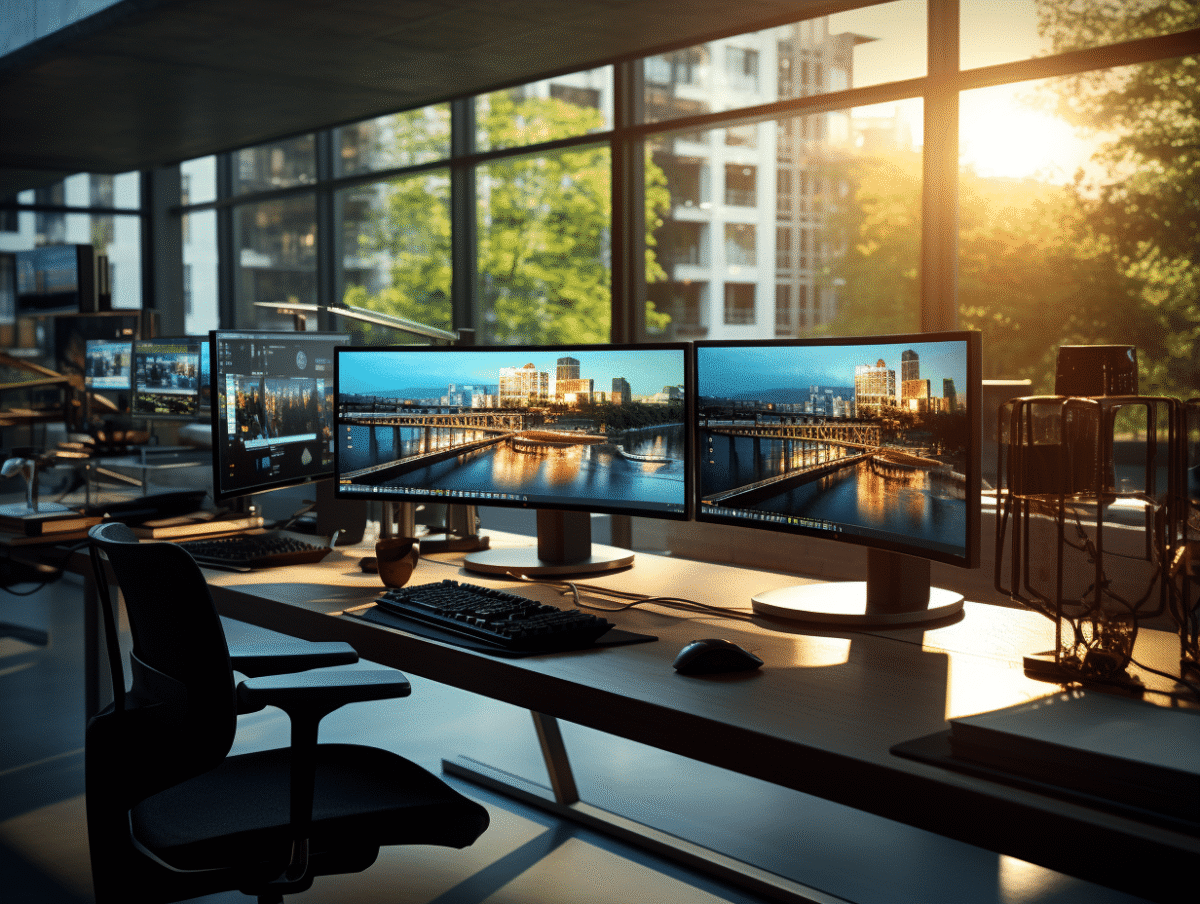
Technological evolution has allowed video game developers to push the boundaries of visual immersion, refining graphic details for an increasingly realistic and captivating user experience. From high-definition textures to dynamic lighting effects, as well as smooth motion rendering and advanced shading techniques, every graphic element is meticulously optimized to engage the player’s senses. These improvements are not limited to aesthetic aspects; they also contribute to the coherence of the game universe, thereby enhancing the interaction and presence of the player in ever more sophisticated virtual worlds.
Graphic Optimization Techniques for an Immersive Gaming Experience
In the quest for an immersive experience in video games, graphic optimization techniques are valuable allies for developers. The use of artificial intelligence (AI) in game design brings a new dimension to realism and image quality. Algorithms such as Monte Carlo Tree Search, which originated in games like Go, are now applied to physical modeling and trajectory planning for space probes, demonstrating the versatility and power of these tools for game design.
The performance of graphics cards is put to the test as developers rely on platforms like OpenAI Gym or Universe to test and refine their creations. Video game graphic optimization thus becomes an act of balancing visual demands with hardware constraints. Among the techniques used, SSAO (Screen Space Ambient Occlusion) plays a fundamental role in giving objects enhanced depth and realism by calculating how light should interact with surfaces in a three-dimensional space.
The graphic quality in games is no longer a mere attribute; it becomes an essential component for immersing players in increasingly vast and detailed universes. AI, with algorithms like DQN and platforms like Retro, VizDoom, and TORCS, not only optimizes these universes to make them more realistic but also makes them dynamic, capable of reacting and adapting to players’ actions. Graphic optimization, far from being a mere aesthetic issue, becomes a strategic challenge in the interaction between humans and machines in the video game industry.

The Challenges and Solutions of Graphic Optimization in Video Game Development
The challenges of graphic optimization in the video game industry are numerous. They require developers to constantly adapt to technological advancements, such as progress in artificial intelligence. Procedural content generation, for example, allows for the creation of vast and varied worlds, but also raises questions about the uniqueness and aesthetic coherence of environments. Organizations such as DeepMind and OpenAI, with their contributions to systems like AlphaStar and OpenAI Five, are pushing the boundaries of artificial intelligence in video games, offering innovative solutions for increasingly complex and reactive universes to players’ actions.
To fully immerse players in these universes, developers rely on platforms such as Universe and Retro. They allow for testing AI algorithms in various contexts, ranging from classic games to more sophisticated simulations. Environments like VizDoom and TORCS also host competitions aimed at evaluating the performance of AI agents, transforming game design into a laboratory for experimentation in human-machine interactions.
Solutions abound to address these challenges. Artificial intelligence introduces revolutionary methods like RND (Random Network Distillation) or PPO (Proximal Policy Optimization), which refine the decision-making of AI agents and their ability to evolve in dynamic environments. The development of algorithms like DQN (Deep Q-Network) by DeepMind and their application in games such as Dota 2 demonstrate the potential of these technologies to produce immersive and engaging experiences. The work of these entities highlights the synergy between graphic optimization and artificial intelligence, essential for propelling video games into unexplored frontiers of realism and interaction.