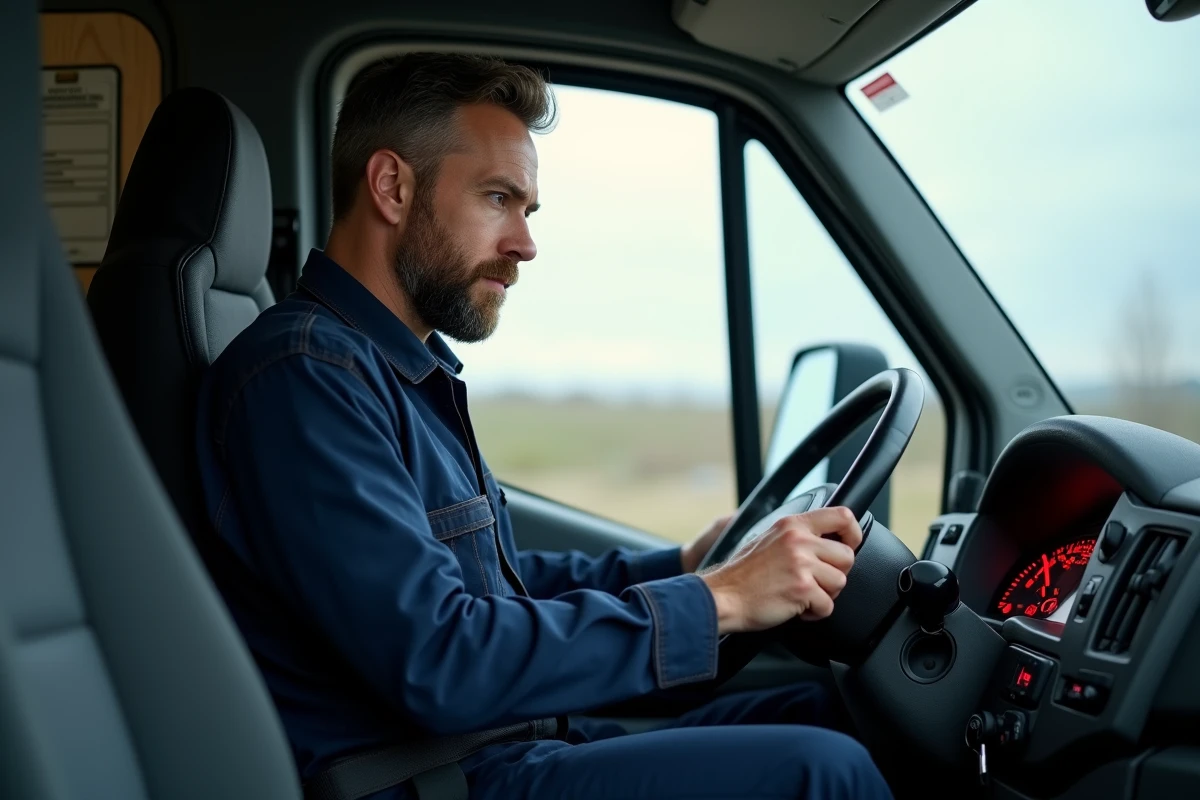
A red warning light that appears on the dashboard leaves no room for hesitation. Unlike the yellow or orange light, it demands an immediate reaction; otherwise, the mechanics, safety, or even the mobility of the vehicle can collapse within a few kilometers. The Iveco Daily is equipped with several red warning lights, each carrying a specific alert, the severity of which varies depending on the detected fault. Quickly identifying their meaning and adopting the correct response is key to minimizing risks and preserving the vehicle’s lifespan.
Why do red warning lights on an Iveco Daily deserve your full attention?
On the dashboard of an Iveco Daily, each red warning light never lights up by chance: it confronts you with an immediate risk, whether related to safety or mechanics. Red does not suggest; it commands. This universal color code imposes action: stopping the vehicle, checking the engine oil level, monitoring the oil pressure, or keeping an eye on the braking system. Ignoring one of these signals exposes the engine, and sometimes the occupants, to unforgiving consequences.
The red warning lights on the Iveco Daily clearly mark the boundary between preventive maintenance and a serious breakdown. On some models, this warning is accompanied by an audible signal that is hard to ignore. Low oil pressure, overheating coolant, insufficient brake fluid level: each alert calls for an immediate and appropriate reaction. Recognizing these messages can prevent many disappointments.
The meaning of the warning lights on an Iveco is not something you invent. It is learned from the manual and maintained with regular attention to maintenance. Some signals, like the red exclamation point, require heightened vigilance. For those who wish to delve deeper, the page “Red Exclamation Point Warning Iveco Daily: Meaning and Actions – Antoine le Pilote” details typical cases and instructions to follow.
When faced with a dashboard alert, every minute counts. Ignoring the message from a red warning light is a high-stakes gamble, leading to costly repairs and compromised safety. Vigilance cannot wait, nor can the diagnosis.
Decoding each red warning light: meaning and associated risks
Understanding the meaning of red warning lights on an Iveco Daily leaves no room for approximation. Each symbol, each pictogram, indicates a specific danger, often related to safety or the vehicle’s condition. If the low oil pressure warning light illuminates, turn off the engine without delay: lubrication is lacking, and failure is unforgiving.
The coolant temperature warning light requires an immediate stop. Continuing to drive risks fatal engine overheating. As for the “red exclamation” light on the dashboard, it signals a serious braking or parking brake issue. On some models, it also indicates a drop in brake fluid level.
Here are the main red warning lights to know on an Iveco Daily, along with their concrete implications:
- Engine warning light: it indicates a failure in the pollution control system or the injection circuit. This signal requires prompt attention.
- ABS or ESP warning light: an anomaly affects the driving assistants. The vehicle’s stability may be compromised.
- Airbag warning light: an electronic fault may deactivate the airbag in the event of an accident.
The list of Iveco Daily warning lights also includes the battery light, often caused by a faulty alternator or a worn-out battery, and the particulate filter warning light: it indicates that the filter is clogged and that intervention is necessary to prevent blocking the entire pollution control system.

When a red warning light comes on: what actions to take to protect your vehicle?
A red warning light lights up on the dashboard of your Iveco Daily: there is no room for improvisation here. The message delivered calls for calm and rigor. Safety, mechanical condition, and the lifespan of your utility vehicle are at stake in these moments. The right reflex? Release the accelerator, stop the vehicle in a safe place. Resuming driving, even briefly, risks exacerbating a problem already identified by the onboard system.
Before intervening, open the owner’s manual. Each red warning light has its meaning, degree of urgency, and course of action. If the engine oil pressure is low, turn off the engine immediately. In case of an alert related to the brake or parking brake, check the tightness, inspect the fluid level, and keep in mind that a serious fault may still be possible.
To react without error, proceed step by step:
- Check the engine oil level after stopping, with the engine cold, to avoid any inaccurate readings.
- Examine the battery: a red warning light may indicate a charging issue or a battery nearing the end of its life.
- Consult a specialized workshop or perform an Iveco diagnostic if the warning light remains on after your checks.
The resetting of certain electronic systems may be necessary, but never without having made a precise diagnosis. Some warning lights require the intervention of a professional equipped with the appropriate tool for the Iveco Daily. Do not neglect any alert: each dashboard signal anticipates a problem that could escalate into a severe breakdown or costly repairs if nothing is done.
In the face of these red signals, the best course remains vigilance and immediate action. It’s the price to pay for driving long and without unpleasant surprises, with the steering wheel in hand and a calm engine.