
The Swiss used car market among professionals has legal and technical particularities that most buying guides overlook. Choosing a used vehicle in Switzerland from an authorized garage is not just about comparing prices and mileage: the contractual structure, legal warranties, and the actual condition of the powertrain deserve much closer scrutiny.
Legal Warranty and Contractual Clause on a Used Vehicle in Switzerland
The absence of a right of withdrawal is the first trap. Contrary to what many buyers assume, once the contract is signed with a Swiss professional, there is no legal 14-day period to return the vehicle. Any possibility of exchange or buyback must be explicitly stated in the contract or in the seller’s terms.
The legal warranty against defects generally lasts for two years from the date of delivery. For a used vehicle, the professional can reduce this period to one year, but this reduction must be clearly stated in the contract. We recommend checking three points before signing:
- The exact duration of the legal warranty mentioned in the contract (one year or two years), and any possible exclusions (wear parts, clutch, tires).
- The existence or not of a commercial warranty from the garage, distinct from the legal warranty, with its precise scope (mechanics only, electronics included, reimbursement cap).
- The remaining manufacturer’s warranty, transferable or not depending on the brand and country of origin of the vehicle.
Confusing these three levels of protection is akin to signing without a safety net. A serious professional clearly distinguishes them in their sales documents. If the seller lumps everything under the vague term “warranty,” it’s a warning sign.
Established professionals like those listed on autowog.ch generally display this contractual information in a structured manner, making it easier to compare offers.
Independent Expertise and Hidden Defects: What the Certificate Doesn’t Say
The certificate of conformity and the technical inspection report attest to the regulatory status of the vehicle at a given date. They do not cover the actual maintenance history, past structural repairs, or any tampering with the odometer.
An independent inspection before purchase remains the most reliable lever to detect anomalies invisible on an official document. An expert appointed by the buyer (and not by the selling garage) inspects the consistency between the displayed mileage, the wear of components, and the maintenance log history.
In Switzerland, odometer tampering constitutes a hidden defect. The professional seller is legally responsible for it. However, it must be proven. Documented expertise before signing creates a factual basis that can be used in case of subsequent disputes.
Priority Points to Check
Beyond the classic mechanical components (brakes, suspension, steering), we observe that buyers often neglect the onboard electronics. A complete OBD diagnostic reveals erased fault codes, interventions on the control units, and calibration inconsistencies. On recent models, the cost of replacing an electronic module can exceed that of a heavy mechanical repair.
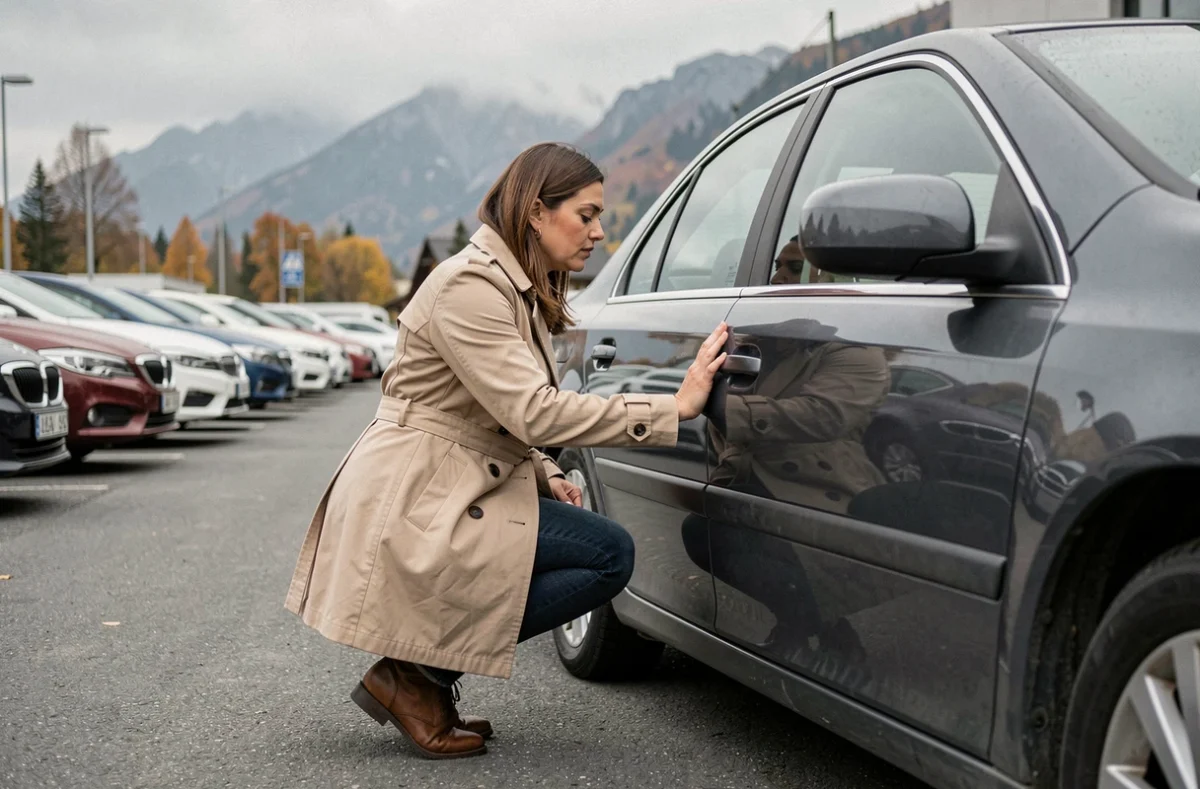
The condition of the bodywork deserves a check with a gauge or, if not possible, a paint thickness measurement. A localized excess thickness indicates a repaint following a collision, even if the vehicle has never been declared a total loss.
Electric and Plug-in Hybrid Used Cars: Specific Criteria for the Swiss Market
The Swiss used electric car market has significantly democratized. For buyers, this means a wider choice but also an increased risk of encountering degraded batteries if the analysis remains superficial.
Mileage alone does not reflect the condition of a traction battery. Two vehicles displaying the same odometer may have very different residual capacities depending on charging conditions (frequent fast charging vs. slow home charging), usage climate, and the number of full cycles.
We recommend systematically requesting a battery diagnostic report (State of Health) performed by a tool certified by the manufacturer. A SoH below 80% on a vehicle less than five years old indicates abnormal degradation.
Plug-in Hybrids: Real Range and Charging History
Registrations of plug-in hybrid models have increased in Switzerland in the first half of 2026. The used car supply will therefore expand. The classic trap is to rely on the homologated electric range. In real conditions (low temperature, highway, active heating), the range drops significantly.
Check if the vehicle has actually been charged regularly. A plug-in hybrid used only in thermal mode has engine wear comparable to that of a conventional gasoline vehicle, while also bearing the permanent extra weight of the battery on the running gear. The charging history, when accessible via the manufacturer’s app, provides a reliable indication of actual usage.

Insurance and Registration: Anticipating Post-Purchase Costs
The price displayed by a professional only covers part of the actual acquisition cost. Car insurance in Switzerland varies greatly depending on the canton of residence, the driver’s profile, and the market value of the vehicle. A recent premium model in the used market can generate an annual premium exceeding the planned budget.
Registration requires the presentation of a valid certificate of conformity and, for some vehicles imported from another country, a supplementary homologation procedure. For a purchase from a Swiss professional for a Swiss resident, these procedures are generally handled by the garage, but the cost is sometimes billed separately.
Before signing, request a written breakdown including the price of the vehicle, administrative registration fees, the cost of the valid technical inspection, and any potential compliance costs. A transparent professional provides this detail without being asked.