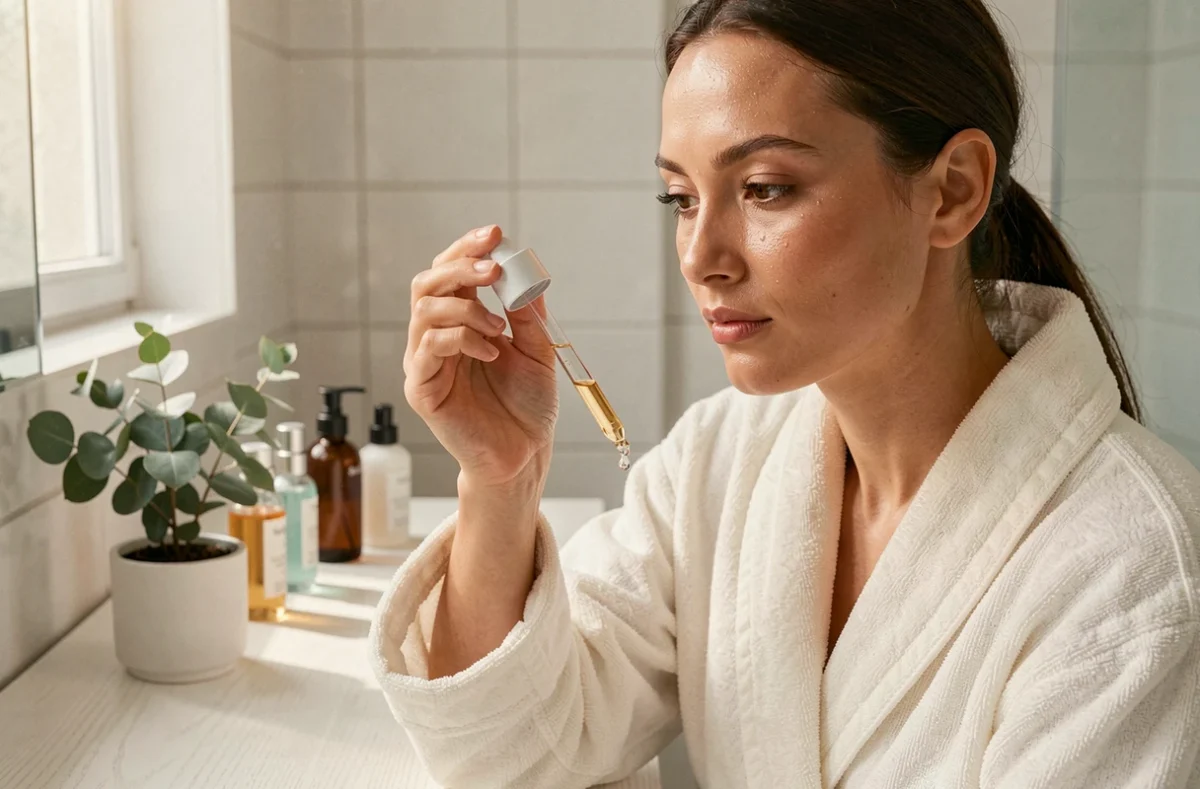
The choice of an active ingredient or texture is not enough to make a beauty routine effective. The order of application, the compatibility between formulas, and respect for skin pH determine the actual effectiveness of the products applied to the face and body daily.
Compatibility of actives in a facial routine
Layering a vitamin C serum in the morning and then following with niacinamide does not pose a stability issue, contrary to popular belief. However, combining retinol and exfoliating acids in the same routine weakens the skin barrier and causes irritation, especially on reactive skin.
The European regulations have evolved on this point. Regulation 2024/996 imposes new restrictions on certain forms of vitamin A in cosmetics. Affected products must comply by November 1, 2025, and those that do not will be removed from sale starting May 1, 2027.
Specifically, if your night cream contains retinol, check the allowed concentration and avoid adding an acid peel. Instead, alternate nights: one night retinol, one night glycolic or lactic acid. This alternation preserves anti-aging effectiveness without compromising skin tolerance.
Several formulations available on the Beauté en Folie website detail these active ingredient combinations according to skin type, making it easier to build a coherent routine.

Patch test before integrating a new product
Test a product twice a day for seven to ten days on a small area before applying it to the entire face: this is the recommendation of the American Academy of Dermatology. This simple protocol detects allergic reactions or intolerances to an ingredient before they manifest on a larger surface.
The inside of the elbow or the back of the ear are suitable for this test. If no redness, itching, or tightness appears after this period, the product can be added to the daily routine.
Misleading claims on packaging
One point deserves special attention for sensitive skin. The terms “fragrance-free” and “unscented” are not equivalent. The AAD notes that products labeled “unscented” may contain fragrance substances used to mask the smell of raw materials. For reactive skin, prioritize the “fragrance-free” label or check the INCI list for common fragrance allergens (linalool, limonene, citronellol).
Daily sun protection and common mistakes
Applying SPF in the morning does not protect all day. The European Commission reminds us that the effectiveness of a sunscreen depends as much on the amount applied as on the SPF displayed. Reapplying every two hours remains the rule, even on cloudy days.
The most common mistakes regarding sun protection:
- Applying an insufficient amount, which reduces the actual protection well below the SPF indicated on the tube
- Forgetting exposed areas like the neck, ears, and backs of hands, which age prematurely without protection
- Assuming that an SPF integrated into a moisturizer or foundation is sufficient, while the amount of product applied is rarely enough to achieve the claimed protection level
Sunscreen should be applied as the last step of skincare, after serum and moisturizer, but before makeup. This layering respects the rule of applying the lightest texture first and the thickest last.

Daily body cleansing and hydration
The face often monopolizes attention in most beauty routines, but the skin on the body represents a much larger surface and undergoes constant mechanical aggression (friction from clothing, shaving, exposure to temperature variations).
Body cleansing does not require soap on the entire skin surface. Areas that produce little sebum (legs, arms) usually only need rinsing with water. Reserve the cleanser for folds and areas prone to sweating to preserve the hydrolipidic film.
Hydration on damp skin
The timing of application makes all the difference. Applying a cream or balm on slightly damp skin, within three minutes after showering, significantly improves the absorption of moisturizing agents. Damp skin is more permeable and retains oils better.
For hair, the same principle applies: a leave-in treatment should be applied to towel-dried hair, never on dry hair, for even distribution of the product and better absorption of actives.
Building a stable and progressive beauty routine
Changing products too often prevents evaluating their effectiveness. A serum or night cream requires several weeks of regular use before producing visible results on the skin.
The most reliable method to enhance your daily beauty routine is to:
- Introduce only one new product at a time, following the patch testing protocol described above
- Keep the basic skincare (cleanser, moisturizer, SPF) as a permanent foundation, and only vary the targeted actives according to the season or skin condition
- Adjust the texture of products to the temperature: a lightweight emulsion in summer, a richer balm in winter, without changing actives
The stability of a routine matters more than the number of steps. Three well-chosen products, applied in the correct order and consistently, yield better results than a complex protocol abandoned after two weeks.