Thirty colleagues in a meeting room, an association seminar, or a family brunch: coffee remains the most requested beverage, but often a liter or two is thrown away due to improper dosing. Calculating the amount of coffee for 30 people relies less on a magic formula than on a few concrete variables that are almost always forgotten.
Actual consumption rate: not everyone drinks coffee
The first instinct is to multiply 30 by one cup. This is a mistake. Feedback compiled by Meeting Professionals International (“Coffee Consumption Patterns at Business Events,” 2023) shows that about 60 to 70% of participants actually have coffee, even when it is offered. In a group of 30, it is more common to serve 18 to 20 cups than 30.
This rate varies depending on the time of day. At breakfast, the proportion increases. In the mid-afternoon or during a cocktail, it decreases. If the break is organized at 10 a.m. in a professional context, aiming for 20 to 22 cups meets the demand without generating waste.
To know precisely how much coffee to prepare for 30 people, we also consider the growing share of tea or herbal tea drinkers. The firm CHD Expert noted in its report “Hot Beverage Trends in BtoB” (2024) a downward trend in coffee consumption per person since 2022, linked to the rise of caffeine-free alternatives. Planning for a thermos of tea and a thermos of herbal tea to complement the offering is not trivial.
Ground coffee dosage and water volume for 20 effective cups
Once the number of cups is estimated, it needs to be converted into grams of ground coffee and liters of water. The most reliable calculation base for a drip coffee maker is around 7 g of ground coffee for 125 ml of water per cup.
Calculation for a standard break
For 20 cups of 125 ml, you need 2.5 liters of water and about 140 g of ground coffee. If you prefer larger mugs (200 ml), the water volume increases to 4 liters and the amount of ground coffee rises to about 220 g.
In practice, a level tablespoon of ground coffee weighs between 5 and 7 g depending on the grind. Without a scale, counting two tablespoons per 200 ml mug remains a functional guideline.
Adjusting intensity without recalculating everything
For a stronger coffee, add more ground coffee without changing the water volume. The opposite yields a lighter coffee. Changing the amount of water rather than the coffee produces an unbalanced extraction: too much water on little grind results in a watery and bitter outcome (over-extraction), while too little water on a lot of grind produces an acidic and underdeveloped coffee.
- Standard coffee: 7 g of grind for 125 ml of water, or about 55 to 60 g per liter
- Strong coffee: increase to 70 g per liter without changing the water volume
- Light coffee: decrease to 45 g per liter, suitable for long breaks where participants refill
Decaffeinated and alternatives: a share not to underestimate
Feedback varies on this point depending on the audience type, but Santé publique France reminds us that people sensitive to caffeine (sleep disorders, arrhythmias, pregnant women) are increasingly asking for decaffeinated options. Some professional event organizers now apply a ratio of one decaffeinated thermos for every three thermoses of regular coffee for groups of 20 to 40 people.
Ignoring this demand pushes part of the group towards still water by default. On a buffet or at a seminar, visibly offering decaffeinated coffee alongside regular coffee reduces the waste of regular coffee (the indecisive do not serve themselves “by default”) and satisfies a segment that is often overlooked.

Equipment and logistics for serving coffee to 30 people
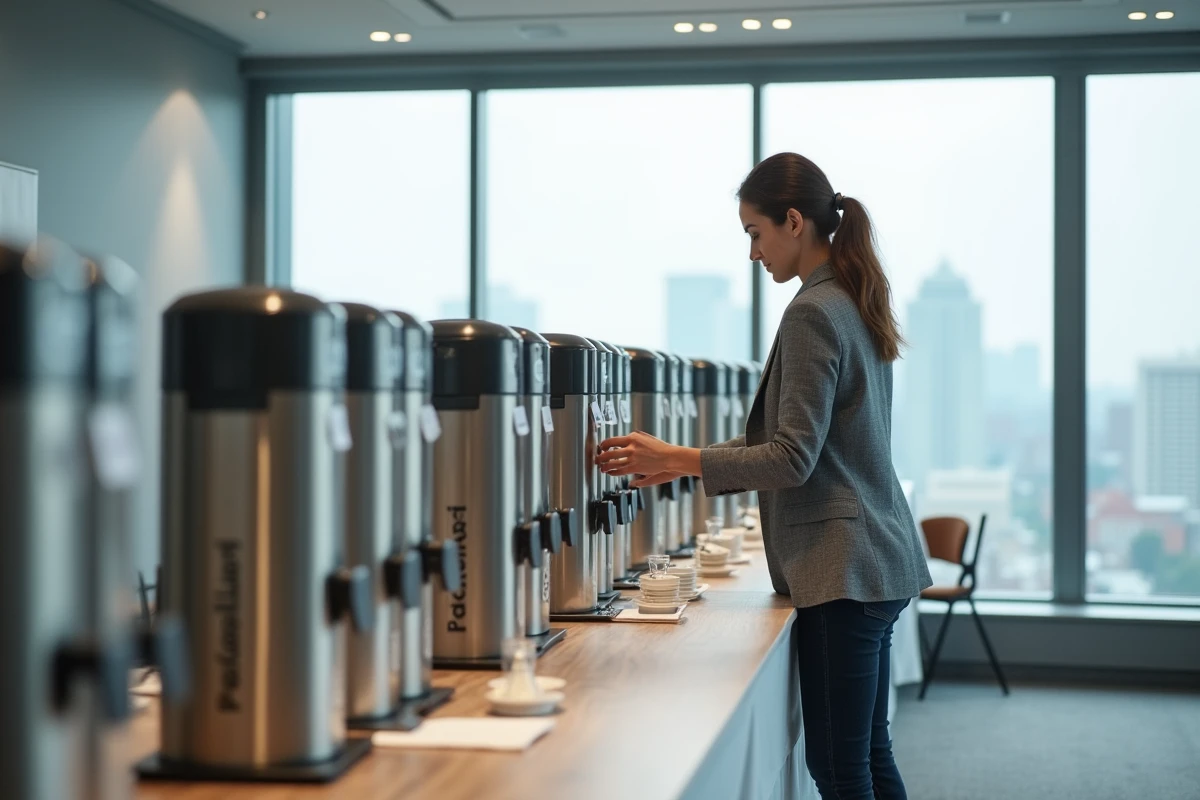
The choice of equipment depends on the location and access to electricity. In an equipped room, a large-capacity drip coffee maker (1.5 to 1.8 liters) allows for the preparation of 10 to 12 cups in one round. Two coffee makers in rotation can meet the demand in less than 30 minutes.
Without electricity or outdoors, gas percolators or pre-filled thermos systems remain the most reliable solutions. Coffee is prepared in advance, two or three 2-liter insulated thermoses are filled, and service is immediate upon the guests’ arrival.
Logistics checklist for a smooth coffee break
- Plan for 2.5 to 4 liters of ready coffee depending on cup size, plus 1 liter of decaffeinated
- Add a thermos of tea and one of hot water for herbal teas (covers the non-coffee share of the group)
- Sugar, milk or plant-based drink, stirrers: count at least one set for 10 people to avoid queues
- Cups or mugs: plan for 10 to 15% more than the number of guests (people set down their cup and take another)
Summary table: amount of coffee according to group profile
| Scenario | Estimated cups | Water | Ground coffee |
|---|---|---|---|
| Professional break (10 a.m., 30 people) | 20-22 cups of 125 ml | 2.5-2.8 L | 140-155 g |
| Family brunch (30 people, mugs) | 18-20 mugs of 200 ml | 3.6-4 L | 200-220 g |
| Day seminar (30 people, 2 breaks) | 35-40 cups total | 4.5-5 L | 250-280 g |
The classic trap is to prepare 30 cups for 30 people. By adjusting to the actual consumption rate and diversifying the offering with decaffeinated coffee and tea, waste is reduced while meeting everyone’s expectations. It is better to refill a coffee maker during the break than to throw away a liter and a half of lukewarm coffee at the end.